 Add to Chrome
 Add to Firefox
 Add to Edge
Neural Collapse by Design: Learning Class Prototypes on the Hypersphere
May 21, 2026
Supervised classification has a theoretical optimum, Neural Collapse (NC), yet neither of its two dominant paradigms reaches it in practice. Cross entropy (CE) leaves radial degrees of freedom unconstrained and converges to a degenerate geometry, while supervised contrastive learning (SCL) drives features toward NC during pretraining but discards this structure in a post hoc linear probing phase. We show that both paradigms are different appearances of the same method that contrasts prototypes on the unit hypersphere, and that closing the gap requires fixing each at its point of failure. From the CE side, we propose NTCE and NONL, two normalized losses that import contrastive optimization's missing ingredients into classifier learning: a large effective negative set and decoupled alignment and uniformity terms. From the SCL side, we prove that SCL's objective already optimizes throughout training for a principled classifier whose weights are the class mean embeddings, making linear probing both redundant and harmful. Empirically, on four benchmarks including ImageNet-1K, NTCE and NONL surpass CE accuracy, closely approximate NC ($\geq 95\%$), and match CE's converged NC on 4/5 metrics in under $7.5\%$ of its iterations, while SCL with fixed prototypes matches linear probing without the hours-long classifier training phase. The learned geometry yields $+5.5\%$ mean relative improvement in transfer learning, up to $+8.7\%$ under severe class imbalance, and improved robustness to corruptions on ImageNet-C. Our work recasts supervised learning as prototype learning on the hypersphere, with NC reached by design.

fmxcoders: Factorized Masked Crosscoders for Cross-Layer Feature Discovery
May 10, 2026Many features in pretrained Transformers span multiple layers: they emerge through stages of inference, persist in the residual stream, or are built jointly by parallel MLPs. Crosscoders (namely, sparse dictionaries trained jointly across layers) aim to recover these cross-layer features in a single shared latent space. We show that standard crosscoders largely fail at this purpose. Although their decoder weight norms spread evenly across layers, a functional coherence metric we introduce reveals that each latent's activation is effectively driven by only one or two layers on average. While functionally coherent latents act as human-interpretable concept detectors (e.g., US states and cities), the layer-localized latents that crosscoders predominantly learn collapse onto surface-level patterns such as digit detectors. We trace this failure to two structural limitations: unconstrained cross-layer parameterization and unregularized cross-layer dependence. We address both by introducing fmxcoders, which (i) replace the encoder and decoder with low-rank tensor factorizations that draw every latent's per-layer weights from a shared cross-layer basis, and (ii) apply stochastic layer masking, a denoising regularizer along the layer axis that penalizes latents whose contribution collapses when a single layer is masked. Across GPT2-Small, Pythia-410M, Pythia-1.4B, and Gemma2-2B, fmxcoders lift mean probing F1 by 10-30 points, surpassing per-layer SAE baselines that standard crosscoders fail to reach, reduce reconstruction MSE by 25-50%, and roughly double mean functional coherence. An LLM-as-a-judge evaluation further shows that fmxcoders recover 3-13$\times$ more semantically coherent latents than standard crosscoders across all four base LLMs.
A Principled Framework for Multi-View Contrastive Learning
Jul 09, 2025Contrastive Learning (CL), a leading paradigm in Self-Supervised Learning (SSL), typically relies on pairs of data views generated through augmentation. While multiple augmentations per instance (more than two) improve generalization in supervised learning, current CL methods handle additional views suboptimally by simply aggregating different pairwise objectives. This approach suffers from four critical limitations: (L1) it utilizes multiple optimization terms per data point resulting to conflicting objectives, (L2) it fails to model all interactions across views and data points, (L3) it inherits fundamental limitations (e.g. alignment-uniformity coupling) from pairwise CL losses, and (L4) it prevents fully realizing the benefits of increased view multiplicity observed in supervised settings. We address these limitations through two novel loss functions: MV-InfoNCE, which extends InfoNCE to incorporate all possible view interactions simultaneously in one term per data point, and MV-DHEL, which decouples alignment from uniformity across views while scaling interaction complexity with view multiplicity. Both approaches are theoretically grounded - we prove they asymptotically optimize for alignment of all views and uniformity, providing principled extensions to multi-view contrastive learning. Our empirical results on ImageNet1K and three other datasets demonstrate that our methods consistently outperform existing multi-view approaches and effectively scale with increasing view multiplicity. We also apply our objectives to multimodal data and show that, in contrast to other contrastive objectives, they can scale beyond just two modalities. Most significantly, ablation studies reveal that MV-DHEL with five or more views effectively mitigates dimensionality collapse by fully utilizing the embedding space, thereby delivering multi-view benefits observed in supervised learning.
Towards Interpretability Without Sacrifice: Faithful Dense Layer Decomposition with Mixture of Decoders
May 27, 2025Multilayer perceptrons (MLPs) are an integral part of large language models, yet their dense representations render them difficult to understand, edit, and steer. Recent methods learn interpretable approximations via neuron-level sparsity, yet fail to faithfully reconstruct the original mapping--significantly increasing model's next-token cross-entropy loss. In this paper, we advocate for moving to layer-level sparsity to overcome the accuracy trade-off in sparse layer approximation. Under this paradigm, we introduce Mixture of Decoders (MxDs). MxDs generalize MLPs and Gated Linear Units, expanding pre-trained dense layers into tens of thousands of specialized sublayers. Through a flexible form of tensor factorization, each sparsely activating MxD sublayer implements a linear transformation with full-rank weights--preserving the original decoders' expressive capacity even under heavy sparsity. Experimentally, we show that MxDs significantly outperform state-of-the-art methods (e.g., Transcoders) on the sparsity-accuracy frontier in language models with up to 3B parameters. Further evaluations on sparse probing and feature steering demonstrate that MxDs learn similarly specialized features of natural language--opening up a promising new avenue for designing interpretable yet faithful decompositions. Our code is included at: https://github.com/james-oldfield/MxD/.
Enabling Local Editing in Diffusion Models by Joint and Individual Component Analysis
Sep 02, 2024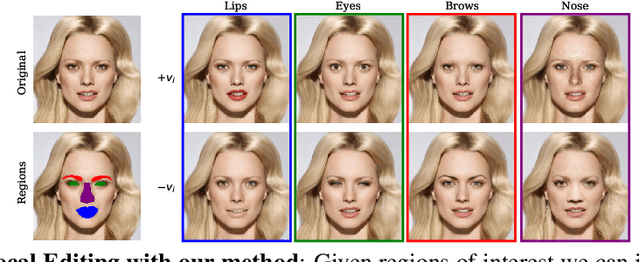

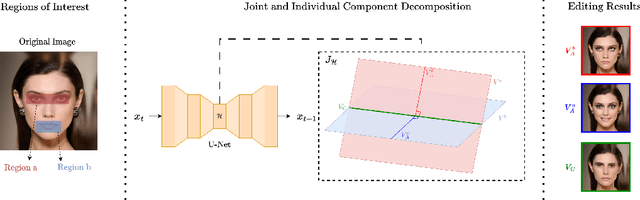
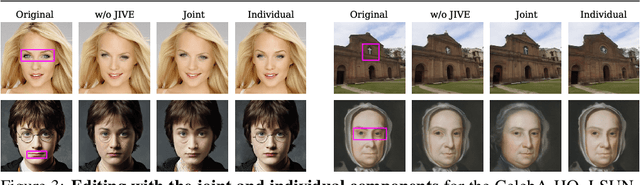
Recent advances in Diffusion Models (DMs) have led to significant progress in visual synthesis and editing tasks, establishing them as a strong competitor to Generative Adversarial Networks (GANs). However, the latent space of DMs is not as well understood as that of GANs. Recent research has focused on unsupervised semantic discovery in the latent space of DMs by leveraging the bottleneck layer of the denoising network, which has been shown to exhibit properties of a semantic latent space. However, these approaches are limited to discovering global attributes. In this paper we address, the challenge of local image manipulation in DMs and introduce an unsupervised method to factorize the latent semantics learned by the denoising network of pre-trained DMs. Given an arbitrary image and defined regions of interest, we utilize the Jacobian of the denoising network to establish a relation between the regions of interest and their corresponding subspaces in the latent space. Furthermore, we disentangle the joint and individual components of these subspaces to identify latent directions that enable local image manipulation. Once discovered, these directions can be applied to different images to produce semantically consistent edits, making our method suitable for practical applications. Experimental results on various datasets demonstrate that our method can produce semantic edits that are more localized and have better fidelity compared to the state-of-the-art.
Multilinear Mixture of Experts: Scalable Expert Specialization through Factorization
Feb 19, 2024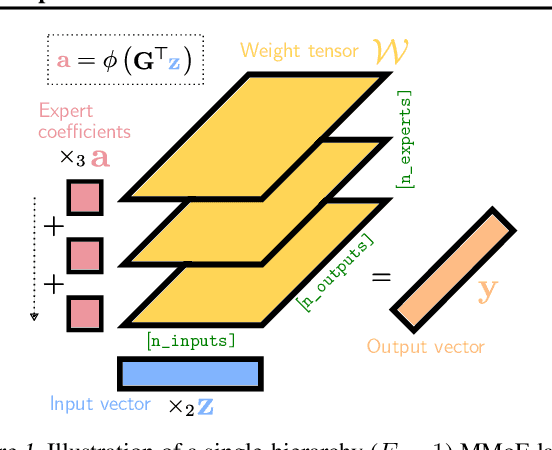



The Mixture of Experts (MoE) paradigm provides a powerful way to decompose inscrutable dense layers into smaller, modular computations often more amenable to human interpretation, debugging, and editability. A major problem however lies in the computational cost of scaling the number of experts to achieve sufficiently fine-grained specialization. In this paper, we propose the Multilinear Mixutre of Experts (MMoE) layer to address this, focusing on vision models. MMoE layers perform an implicit computation on prohibitively large weight tensors entirely in factorized form. Consequently, MMoEs both (1) avoid the issues incurred through the discrete expert routing in the popular 'sparse' MoE models, yet (2) do not incur the restrictively high inference-time costs of 'soft' MoE alternatives. We present both qualitative and quantitative evidence (through visualization and counterfactual interventions respectively) that scaling MMoE layers when fine-tuning foundation models for vision tasks leads to more specialized experts at the class-level whilst remaining competitive with the performance of parameter-matched linear layer counterparts. Finally, we show that learned expert specialism further facilitates manual correction of demographic bias in CelebA attribute classification. Our MMoE model code is available at https://github.com/james-oldfield/MMoE.
Locality-preserving Directions for Interpreting the Latent Space of Satellite Image GANs
Sep 26, 2023
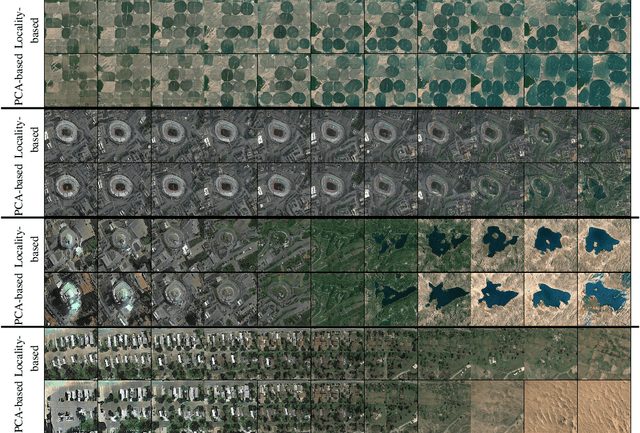
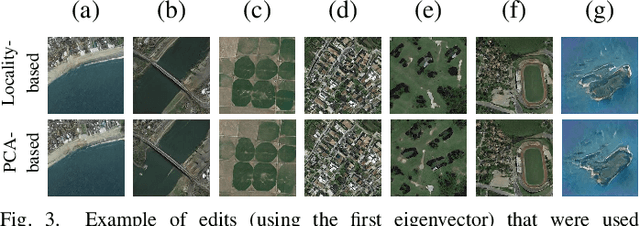
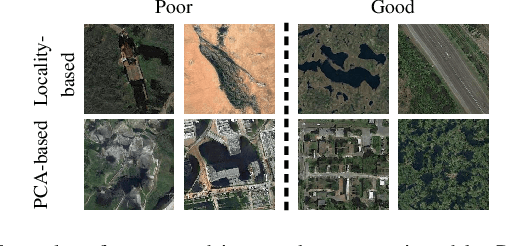
We present a locality-aware method for interpreting the latent space of wavelet-based Generative Adversarial Networks (GANs), that can well capture the large spatial and spectral variability that is characteristic to satellite imagery. By focusing on preserving locality, the proposed method is able to decompose the weight-space of pre-trained GANs and recover interpretable directions that correspond to high-level semantic concepts (such as urbanization, structure density, flora presence) - that can subsequently be used for guided synthesis of satellite imagery. In contrast to typically used approaches that focus on capturing the variability of the weight-space in a reduced dimensionality space (i.e., based on Principal Component Analysis, PCA), we show that preserving locality leads to vectors with different angles, that are more robust to artifacts and can better preserve class information. Via a set of quantitative and qualitative examples, we further show that the proposed approach can outperform both baseline geometric augmentations, as well as global, PCA-based approaches for data synthesis in the context of data augmentation for satellite scene classification.
Parts of Speech-Grounded Subspaces in Vision-Language Models
May 23, 2023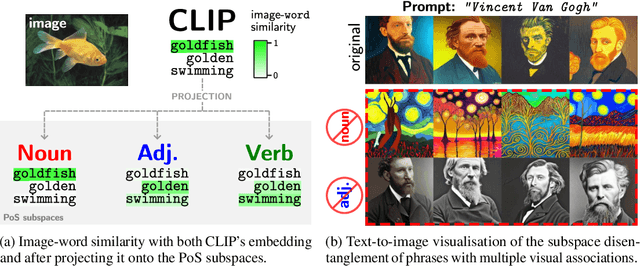

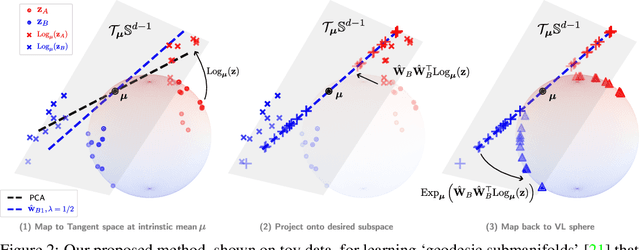

Latent image representations arising from vision-language models have proved immensely useful for a variety of downstream tasks. However, their utility is limited by their entanglement with respect to different visual attributes. For instance, recent work has shown that CLIP image representations are often biased toward specific visual properties (such as objects or actions) in an unpredictable manner. In this paper, we propose to separate representations of the different visual modalities in CLIP's joint vision-language space by leveraging the association between parts of speech and specific visual modes of variation (e.g. nouns relate to objects, adjectives describe appearance). This is achieved by formulating an appropriate component analysis model that learns subspaces capturing variability corresponding to a specific part of speech, while jointly minimising variability to the rest. Such a subspace yields disentangled representations of the different visual properties of an image or text in closed form while respecting the underlying geometry of the manifold on which the representations lie. What's more, we show the proposed model additionally facilitates learning subspaces corresponding to specific visual appearances (e.g. artists' painting styles), which enables the selective removal of entire visual themes from CLIP-based text-to-image synthesis. We validate the model both qualitatively, by visualising the subspace projections with a text-to-image model and by preventing the imitation of artists' styles, and quantitatively, through class invariance metrics and improvements to baseline zero-shot classification. Our code is available at: https://github.com/james-oldfield/PoS-subspaces.
Unsupervised Discovery of Semantic Concepts in Satellite Imagery with Style-based Wavelet-driven Generative Models
Aug 03, 2022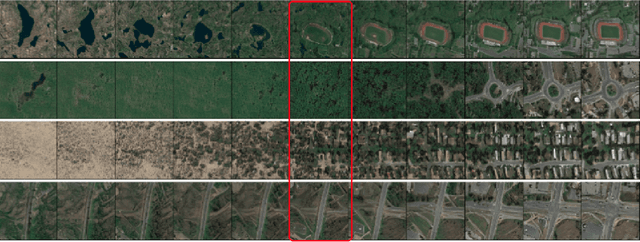
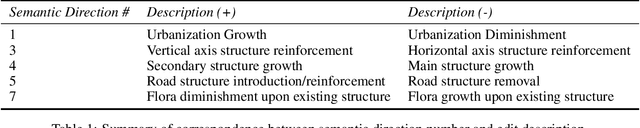
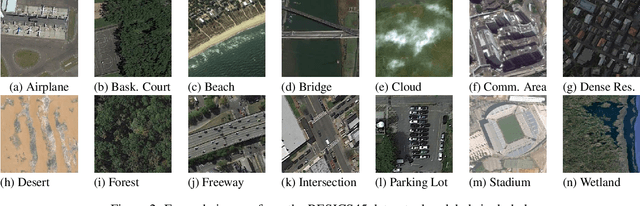
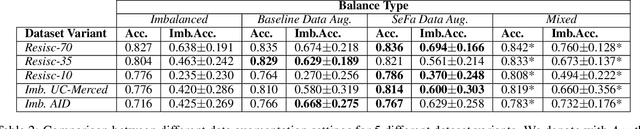
In recent years, considerable advancements have been made in the area of Generative Adversarial Networks (GANs), particularly with the advent of style-based architectures that address many key shortcomings - both in terms of modeling capabilities and network interpretability. Despite these improvements, the adoption of such approaches in the domain of satellite imagery is not straightforward. Typical vision datasets used in generative tasks are well-aligned and annotated, and exhibit limited variability. In contrast, satellite imagery exhibits great spatial and spectral variability, wide presence of fine, high-frequency details, while the tedious nature of annotating satellite imagery leads to annotation scarcity - further motivating developments in unsupervised learning. In this light, we present the first pre-trained style- and wavelet-based GAN model that can readily synthesize a wide gamut of realistic satellite images in a variety of settings and conditions - while also preserving high-frequency information. Furthermore, we show that by analyzing the intermediate activations of our network, one can discover a multitude of interpretable semantic directions that facilitate the guided synthesis of satellite images in terms of high-level concepts (e.g., urbanization) without using any form of supervision. Via a set of qualitative and quantitative experiments we demonstrate the efficacy of our framework, in terms of suitability for downstream tasks (e.g., data augmentation), quality of synthetic imagery, as well as generalization capabilities to unseen datasets.
PandA: Unsupervised Learning of Parts and Appearances in the Feature Maps of GANs
May 31, 2022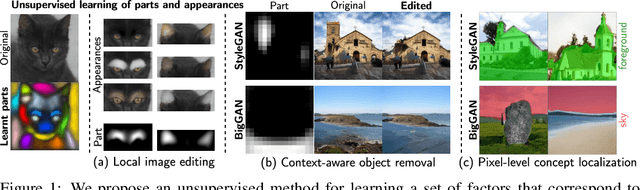

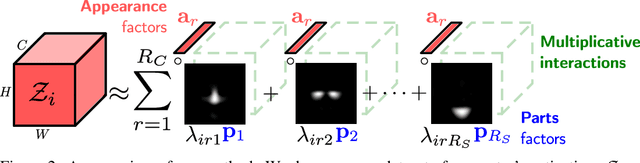
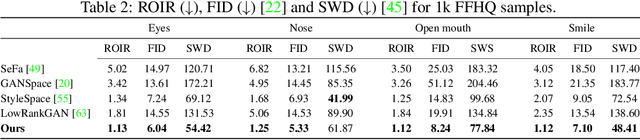
Recent advances in the understanding of Generative Adversarial Networks (GANs) have led to remarkable progress in visual editing and synthesis tasks, capitalizing on the rich semantics that are embedded in the latent spaces of pre-trained GANs. However, existing methods are often tailored to specific GAN architectures and are limited to either discovering global semantic directions that do not facilitate localized control, or require some form of supervision through manually provided regions or segmentation masks. In this light, we present an architecture-agnostic approach that jointly discovers factors representing spatial parts and their appearances in an entirely unsupervised fashion. These factors are obtained by applying a semi-nonnegative tensor factorization on the feature maps, which in turn enables context-aware local image editing with pixel-level control. In addition, we show that the discovered appearance factors correspond to saliency maps that localize concepts of interest, without using any labels. Experiments on a wide range of GAN architectures and datasets show that, in comparison to the state of the art, our method is far more efficient in terms of training time and, most importantly, provides much more accurate localized control. Our code is available at: https://github.com/james-oldfield/PandA.